 Notify Nepal
Loading...

Have you ever ignored a red light or crossed into the wrong lane at the Thapathali intersection on a Saturday, Sunday, or public holiday, assuming there were no traffic police on duty? If so, you may already have been penalised—or could soon face action.
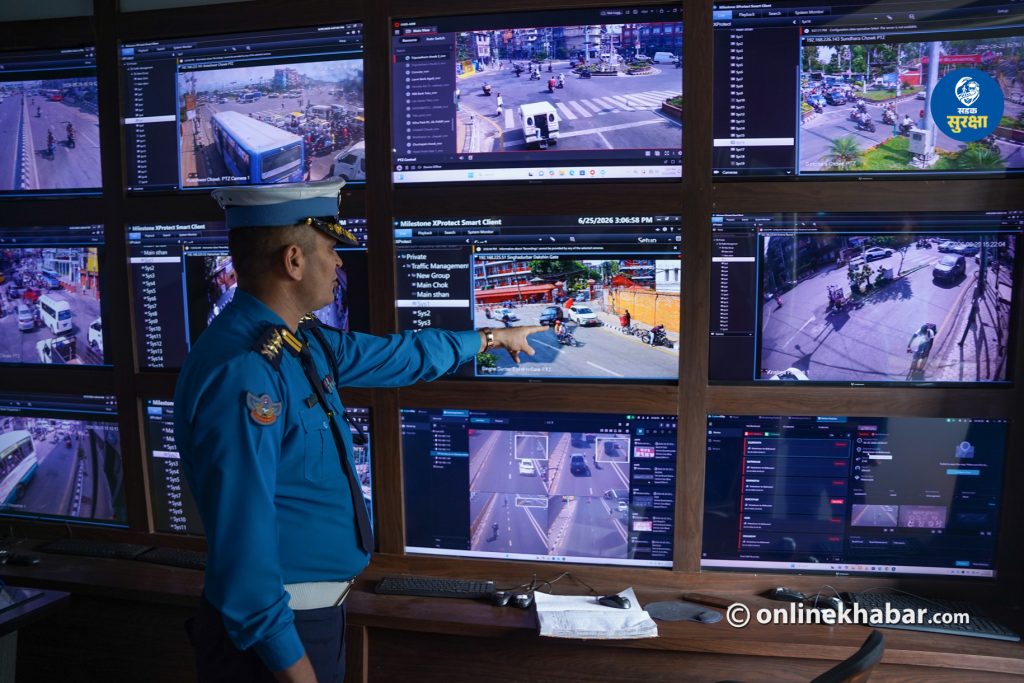
The Kathmandu Valley Traffic Police Office at Ramshah Path has been running a “traffic-free management” campaign at the Thapathali intersection on public holidays for about a month. Although uniformed officers are largely absent from the intersection, traffic monitoring has become more extensive through the use of technology.
The initiative was introduced during the tenure of SSP Nabaraj Adhikari and has been continued by the current chief, SSP Suresh Kafle. He says the goal is to gradually manage traffic without requiring officers to stand on the roads. Public holidays were chosen because vehicle flow is lighter, making it easier to test technology-based monitoring. While some traffic personnel operate in plain clothes on the streets, others monitor traffic from rooftops overlooking the intersection. CCTV cameras continuously record road activity.
If a driver violates traffic rules, plainclothes officers can immediately issue a fine. Violations captured by rooftop cameras and CCTV footage are also used to take action. SSP Kafle says the campaign reflects a long-term plan to modernise traffic management. “With few exceptions, traffic police in most countries do not stand on roads directing vehicles. In Nepal, however, people often follow the rules only when they see a traffic officer blowing a whistle. We are gradually working to change that culture,” he said.
Traffic police took action against 73,299 drivers across the Kathmandu Valley in the past month using various technological systems. The largest share, 24,291 drivers, were penalised through the e-challan system. Unlike traditional paper tickets, e-challans are processed digitally. Drivers receive notifications through Nepal’s Nagarik App, and all enforcement records are automatically stored in the traffic police database.
According to Traffic Police spokesperson and Superintendent of Police (SP) Naresh Raj Subedi:
Traffic officials believe reducing direct interaction between officers and motorists will minimise confrontations and improve the public image of the traffic police. In the future, officers deployed on roads are expected to carry cameras so that violations can be supported with video evidence.

As part of its technology-driven approach, the traffic police has also begun testing robots to conduct traffic awareness classes. A demonstration of the robot was recently unveiled in collaboration with Unity Nepal, and it is currently undergoing trial operations. Initially, the robot is being trained to conduct awareness sessions for drivers penalised for offences such as:
SP Subedi said the robot is currently being trained and assigned various tasks so it can eventually conduct the classes independently.
Traffic police provide awareness classes to around 600 traffic offenders every day. Authorities are also exploring the use of robots to educate pedestrians caught crossing roads improperly. Once fully trained, the robot is expected to wear a traffic police uniform and function as a virtual traffic officer.
The traffic police currently operate six Automatic Number Plate Recognition (ANPR) cameras. These smart cameras can identify vehicle registration plates and even capture drivers’ faces inside vehicles. If a vehicle commits an offence and leaves the scene, the system can recognize the number plate elsewhere and provide officers with the driver’s photograph and vehicle details.
Using optical character recognition technology, the cameras instantly transmit violation alerts to the traffic police monitoring system.
Traffic police continue to rely on breathalyser devices for drink-driving enforcement and drug-testing kits for detecting drivers under the influence of narcotics. Drink-driving checks were introduced during the tenure of former traffic chief Ganesh Rai. The Kathmandu Valley Traffic Police currently operate 100 breathalyser devices, with similar enforcement also conducted in districts outside the valley.
SSP Kafle claims drink-driving enforcement has reduced alcohol-related traffic accidents by as much as 50 per cent. However, authorities say drug-impaired driving is becoming increasingly common. Testing has identified drivers under the influence of narcotics among school bus drivers and even waste collection vehicle operators.
Since April 27, public transport vehicles operating within the Kathmandu Valley have been required to install dashcams or CCTV cameras. Initially, 106 public vehicles, including 101 Sajha Yatayat buses, had installed dashcams. By June 16, that number had risen to 3,303 vehicles.
Vehicle owners are responsible for installing the cameras. The traffic police have also requested the Department of Transport Management to renew public vehicle registrations only after verifying that dashcams or CCTV systems have been installed. SP Subedi said no fixed deadline has been set, but compliance will be checked during the vehicle renewal process.
Authorities believe in-vehicle cameras will help investigate incidents such as pickpocketing, theft, harassment, violence, inappropriate physical contact, driver misconduct, and traffic accidents. They will also help determine the exact sequence of events and identify responsibility in crashes. Mandatory CCTV and dashcam installation is also included in the government’s 100-point governance reform agenda.
Thirty-seven-year-old Binay Aryal recently attended a traffic awareness class after receiving a phone call from the traffic police. Believing there were no officers at the Thapathali intersection on a Saturday, he crossed the intersection while the traffic signal was red.
Two days later, he was informed by phone that he had violated traffic regulations and was instructed to report to the Traffic Police Office. At the office, officers showed him CCTV footage of the incident. He admitted his mistake, paid the fine, and completed the mandatory awareness class.
SP Subedi said CCTV surveillance now allows traffic police to identify and penalise offenders even if they initially escape detection. “Earlier, many drivers believed they had gotten away because no traffic officer was present. Now, CCTV surveillance enables us to identify those drivers and impose penalties,” he said.
Traffic lights remain the backbone of traffic management in Kathmandu. Of the valley’s traffic signals, 48 were damaged during the Gen Z movement protests. After repairs, 61 intersections are currently operating with traffic lights.
However, officials acknowledge that traffic lights alone cannot fully manage traffic because they frequently malfunction. Many are also poorly positioned or not synchronised, creating additional challenges within the valley. Other cities outside Kathmandu face fewer such issues.
Traffic police also use 20 body-worn cameras, 721 portable warning lights, wheel locks, radar guns, laser speed guns, right-control gear, e-challan mobile devices, photo-tapping cameras, and road spikes to support enforcement.
Despite recent technological upgrades, traffic officials say existing resources remain insufficient. Following an inspection by Home Minister Sudan Gurung, who instructed officials to prepare a list of required improvements and equipment, the Traffic Police Office has submitted a comprehensive modernisation plan to the ministry.
Officials say the long-term strategy is to rely increasingly on technology while gradually reducing the need for traffic officers to be physically stationed on roads. “We do not yet have sufficient technology. We have submitted a plan to the ministry outlining the equipment needed to build a technology-friendly traffic management system,” a traffic police official said.
Authorities say the Home Minister supports the initiative and has directed the department to move toward digital traffic management.
A one-month nationwide traffic awareness campaign began on June 15. The campaign involves artists, content creators, and community leaders promoting road safety awareness. Once it concludes, authorities plan to enforce traffic regulations more strictly.
Former Additional Inspector General (AIG) Bhim Dhakal, who also served as chief of the Kathmandu Valley Traffic Police Office, believes Nepal must embrace digital traffic management. “Our leaders have visited many countries. Nowhere do you see traffic police standing in the middle of the road blowing whistles.
Traffic management there is technology-driven,” Dhakal said. “In today’s digital era, it is no longer appropriate to rely on officers standing on roads with whistles. We should digitise traffic management beginning from the main entry points of our major cities.”
The post Kathmandu traffic police shift to technology-driven enforcement appeared first on OnlineKhabar English News.




 AED
AED AUD
AUD BHD
BHD CAD
CAD CHF
CHF CNY
CNY DKK
DKK EUR
EUR GBP
GBP HKD
HKD INR
INR JPY
JPY KRW
KRW KWD
KWD MYR
MYR OMR
OMR QAR
QAR SAR
SAR SEK
SEK SGD
SGD THB
THB USD
USD