 Notify Nepal
Loading...

Gorkha, October 27
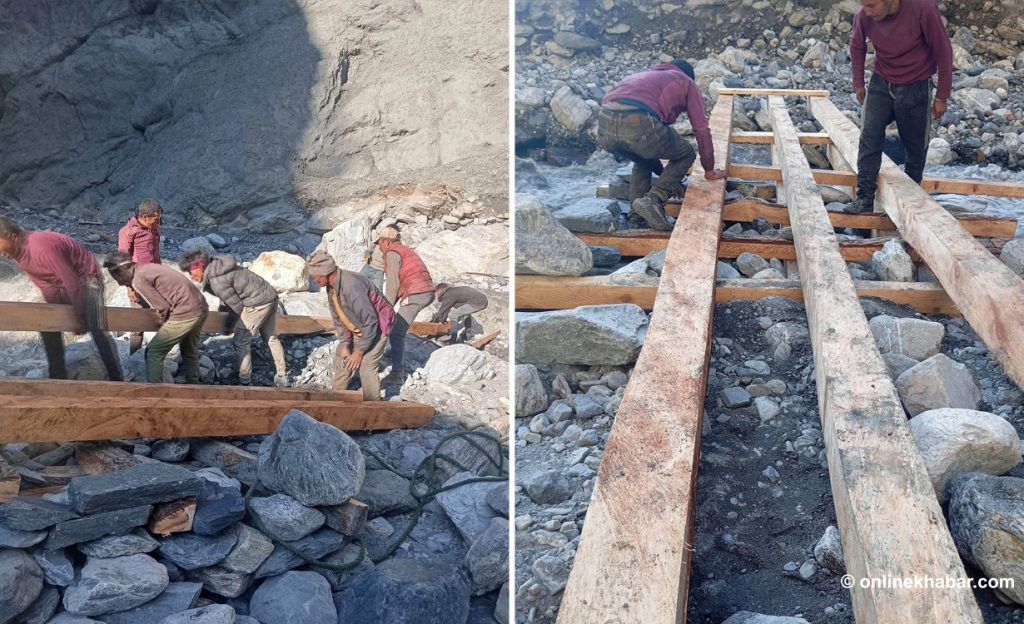
Local residents in Gorkha district have worked for two weeks to restore access to settlements isolated by the devastating Budhigandaki River floods, reopening routes and building temporary bridges to reconnect communities.
The floods on October 11, triggered after an avalanche blocked the Ungilung Stream, caused extensive damage to infrastructure in the lower parts of the district. Several roads and bridges were swept away, cutting off villages and disrupting the movement of people, livestock and essential supplies.
With no alternative route to Tsum Valley, residents began clearing debris and rebuilding access paths soon after the disaster. Their efforts led to the temporary reopening of the Tsum Valley road on Sunday, which had remained closed for 15 days.
Chumnubri Rural Municipality Chair Nima Lama said four wooden bridges had been built across the Syar Stream, allowing people, livestock and mules to move to and from the valley.
Access to Tsum Valley had been disrupted after the flood swept away a cantilever bridge at Sardibhir in Ward No. 6 of Chumnubri Rural Municipality.
According to the District Administration Office in Gorkha, the disaster damaged 108 houses and sheds across Chumnubri, Dharche and Aarughat rural municipalities. The floods also swept away six suspension bridges, two motorable bridges, a Bailey bridge and another cantilever bridge at Yaru.
The local government is coordinating with the Nepali Army and the Gorkha Road Project to restore the obstructed Benighat–Aarughat–Larke road, a key route connecting settlements in the affected areas.
The Gorkha Road Project Office has been clearing the road section between Arukhet and Dobhan, while the Nepali Army is working on the stretch from Dobhan to Salleri. The project office began clearance work the day after the flood.
The Army is also attempting to reopen the road from Salleri in Chumnubri Rural Municipality to Jagat. However, clearing mud and debris deposited along a 1.5-kilometre stretch has proved particularly challenging.
Lieutenant Colonel Ramasagar Yadav, chief of the Army’s road construction task force, said it could take a few more days to clear the debris. He added that pedestrians, mules and motorcycles could reach Pangsing within a few days.
Meanwhile, residents have been working around the clock to reconnect settlements cut off by the disaster.
In Dharche Rural Municipality, villagers built a temporary wooden bridge after the flood swept away both a Bailey bridge and a suspension bridge connecting Dobhan in Ward No. 3 with Hulchuk in Ward No. 1. Movement across the affected section has resumed since last Monday.
Residents also reopened a route between Khorlabeshi in Ward No. 3 and Tatopani within days of the disaster. Electricity wires were strung between Khorlabeshi and Kerauja to help transport essential supplies, while local youths cleared mud and debris from the road between Khorlabeshi and Jagat, making it passable for pedestrians and mules.
Dharche Rural Municipality Chair Laxman Gurung said drones were also used to deliver food supplies to communities facing immediate shortages.
Efforts to restore essential infrastructure have also progressed in the affected areas.
The flood-damaged Sirdibas Uhiya Micro Hydropower Project resumed operations within four days of the disaster, helping restore electricity services.
Meanwhile, repairs to the bridge at Aarughat, which connects Gorkha and Dhading districts, were completed within six days. The Gorkha Road Project Office and the Nepali Army jointly repaired the bridge after it was swept away by the flood, while the Army installed a Bailey bridge to restore traffic along the damaged section.
Larger vehicles, including tipper trucks, have been crossing the bridge since Monday.
Despite extensive damage to roads, bridges and homes, local residents continue to work alongside government agencies to reopen routes, restore essential services and reconnect communities affected by the floods.
The post Budhigandaki floods: Locals spend two weeks restoring access to Tsum Valley appeared first on OnlineKhabar English News.





9 Kartik, 2083





 AED
 AUD
 BHD
 CAD
 CHF
 CNY
 DKK
 EUR
 GBP
 HKD
 INR
 JPY
 KRW
 KWD
 MYR
 OMR
 QAR
 SAR
 SEK
 SGD
 THB
 USD