 नोटिफाई नेपाल
Loading...

In the first meeting of the House of Representatives held after the elections of March 5, Harka Sampang, chair of the Shram Sanskriti Party, raised the issue of asset investigation. He urged that the process begin with incumbent ministers and members of parliament themselves.
“An asset investigation and purification campaign must be launched. First of all, all current cabinet ministers and we, the members of parliament, should be investigated,” Sampang said.
Despite the issue being raised from the very first day of Parliament, members of the Council of Ministers have not yet made their asset details public, even though the Rastriya Swatantra Party (RSP) had mentioned this in its election manifesto.
“We will fully disclose our asset details before assuming public office,” the RSP stated in point no. 16 of its manifesto. The party has prioritised governance reform, corruption control, and digital good governance.
RSP’s joint spokesperson Ramesh Prasai says the party is clear that asset disclosure is necessary.
“Asset details must be made public. It will happen. There has been a slight delay as we have just taken the oath. It will be mandatory for all ministers and MPs to disclose their asset details,” he said to Onlinekhabar. According to him, the party’s central committee members are also required to submit their asset details, though those will remain within party records.
Although ministers have not yet disclosed their assets as per the party’s current commitment, they had submitted such details when they previously joined the government. When the cabinet was reconstituted on March 4, 2024, all RSP ministers had submitted their asset details.
Deputy Prime Minister and Home Minister Rabi Lamichhane, Labour Minister Dol Prasad Aryal, Education Minister Sumana Shrestha, and Sports Minister Biraj Bhakta Shrestha had submitted their asset details to the Office of the Prime Minister and Council of Ministers within the stipulated deadline under the government led by Pushpa Kamal Dahal.
Although the legal deadline has not yet expired, the RSP has not yet implemented its own manifesto commitment.
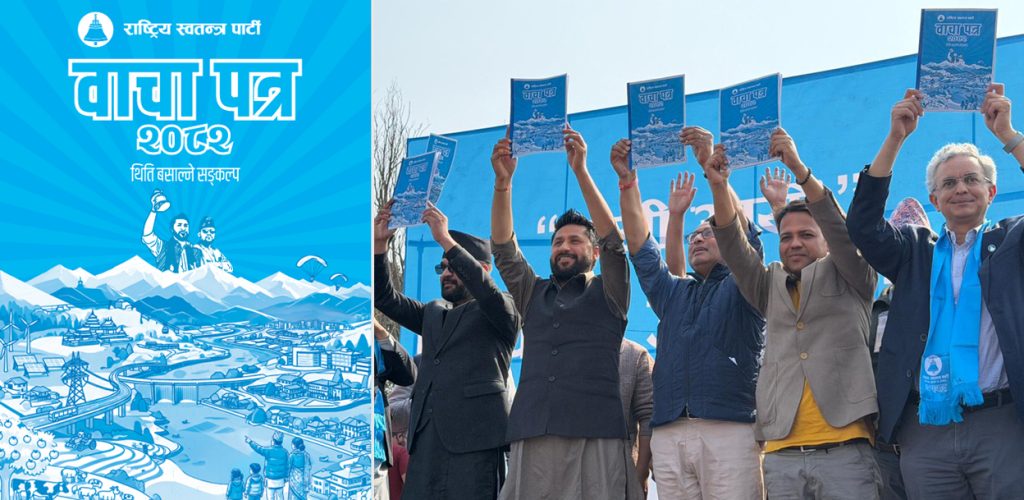
According to point no. 16 of the manifesto, asset details should have already been made public. While unveiling the manifesto, party leaders, including Vice President Swarnim Wagle and senior leader Balen Shah, had said, “This is not just a paper document; it is a commitment to the people.”
The legal provisions regarding asset disclosure of public officials are governed by the Prevention of Corruption Act, 2059. Section 50 of the Act clearly outlines the process and deadlines for submitting asset details.
According to sub-section (1), public officials must submit an updated statement of assets held in their own or their family’s name, including sources, within 60 days of assuming office, and within 60 days after the end of each fiscal year.
For ministers, the authority to which such details must be submitted is the Office of the Prime Minister and Council of Ministers. If the deadline is missed, an additional 30 days may be granted upon showing valid reasons.
Failure to submit within the stipulated time results in a fine of Rs. 5,000 under sub-section (3). Additionally, failure to submit on time may create grounds for the Commission for the Investigation of Abuse of Authority (CIAA) to suspect illegal assets and initiate further investigation.
According to sub-section (4), the submitted asset details are to be kept confidential and may only be disclosed for investigation or inquiry purposes.
Although the 2081 amendment has expanded the scope of public officials and civil servants, it has retained the provision of confidentiality. This means that while the law requires officials to submit asset details to state bodies, it does not mandate public disclosure.
Similarly, Section 31(a) of the CIAA Act, 2048, provides legal authority to demand asset details from public officials. In line with this, the National Vigilance Centre has been collecting such details from employees and officials.
However, the RSP manifesto goes beyond existing law by committing to making asset details public in advance.
Yet, the Balen-led government, which claimed to be in “action” from the very day of oath-taking, has not implemented this commitment. It has been seven days since the formation of the 15-member cabinet, and the term of MPs has already begun.
The government’s 100-point agenda also includes forming a committee to investigate the assets of public officials and high-ranking employees from 2048 BS to the present. However, opposition parties argue that the current ministers should first make their own asset details public.
Shram Sanskriti Party chair Sampang has welcomed the government’s decision to investigate assets but has emphasised that fair implementation should begin with the Prime Minister himself. He wrote on social media:
“The asset investigation should begin with the Prime Minister. The Prime Minister should start from himself, and it should begin with Rabi Lamichhane and Sudan Gurung,” he said, adding, “What movable and immovable assets do they have? Where have they invested? The sources of all these must be disclosed. When a rule is implemented, it should start from oneself.”
Point no. 16 of the manifesto not only commits to disclosing assets before assuming public office but also promises to disclose them again after completing the term.
“Before the election and after completing the term, we will conduct an independent audit of how much our and our family’s assets have changed and make it public,” the manifesto states.
The post RSP fails to deliver on asset disclosure pledge as ministers withhold details appeared first on OnlineKhabar English News.




 AED
AED AUD
AUD BHD
BHD CAD
CAD CHF
CHF CNY
CNY DKK
DKK EUR
EUR GBP
GBP HKD
HKD INR
INR JPY
JPY KRW
KRW KWD
KWD MYR
MYR OMR
OMR QAR
QAR SAR
SAR SEK
SEK SGD
SGD THB
THB USD
USD