 नोटिफाई नेपाल
Loading...

Spain’s extraordinary legalisation process for undocumented immigrants had sparked enormous hope among thousands of Nepalis. But that hope has now turned into confusion, caught in a web of bureaucratic hurdles and administrative complexities.
The Spanish government launched this process to grant legal status to immigrants who arrived in Spain before December 31, 2025, and have been continuously residing there for at least five months. The application window remains open only until June 30.
The process primarily requires a criminal record certificate (police report) as a mandatory document. This prompted thousands of Nepalis living in Spain to file police reports simultaneously.
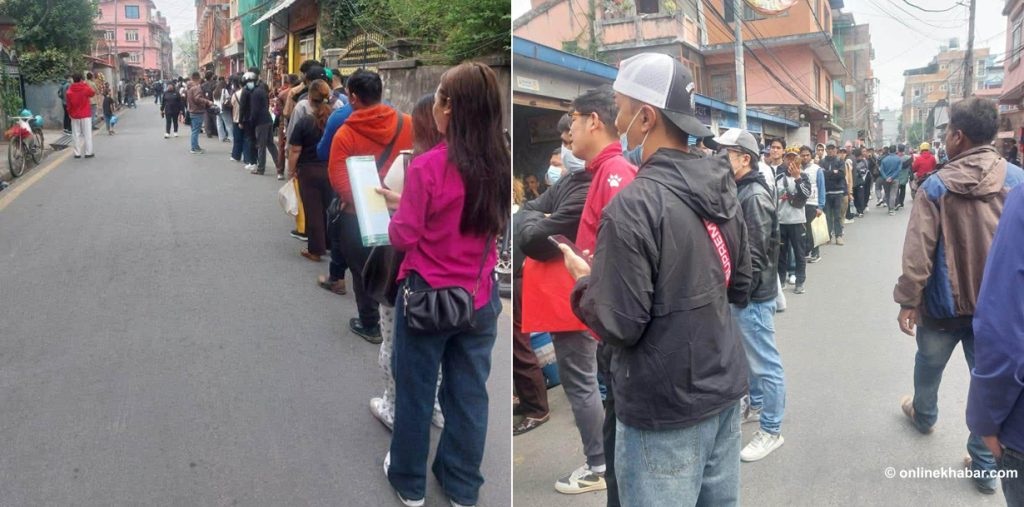
Even after obtaining the police report, applicants were required to get it authenticated by the Spanish Consulate in Kathmandu, causing massive crowds at the consulate in recent weeks, with thousands of applicants waiting for their documents to be verified. Then came another major change.
The Spanish Consulate in Kathmandu has been temporarily stripped of its authority to authenticate Nepali documents, effective April 24, 2026.
Following directives from Spain’s Ministry of Foreign Affairs, such authentication must now be processed exclusively through Spain’s Embassy in New Delhi, India, making the process significantly more complicated.
What was expected to be a straightforward document authentication in Nepal must now travel through Delhi before reaching Madrid, adding time, cost, and procedural uncertainty.
“In accordance with instructions received from the European Union and the Ministry of Foreign Affairs, the authority and responsibility to legalise signatures on Nepali public documents is hereby revoked with immediate effect until further notice,” reads a notice issued by the Spanish Consulate in Kathmandu on April 24, 2026.
The same notice clarifies that applicants must now send their documents for legalisation to Spain’s Embassy in New Delhi, India.
For Dil Bahadur Kshetri of Pokhara Metropolitan City-22, this opportunity has brought more anxiety than joy.
“My son in Spain stayed up all night and stood in line outside the municipal office until morning to get the ‘Certificado de Vulnerabilidad,'” he says to Onlinekhabar. “We had just started to hope that the paperwork was within reach.”
But that hope got stuck right here in Nepal, and now a new complication has been added.
Under the latest notice from the Spanish Consulate in Kathmandu, Nepali documents can no longer be authenticated directly in Kathmandu and must now go through Spain’s Embassy in New Delhi. This has made the process longer, more expensive, and more uncertain.
“There were already problems with queues, crowds, and delays,” Kshetri says. “Now we have to go all the way to Delhi with the papers. It’s going to take even longer.”
He adds, “We had registered our names at the consulate and were waiting to be called. Then this notice came. What do we do now? Do we go straight to Delhi? Do we need an appointment there, too? We have no idea. The confusion and stress have only grown.”
Kabita Rai of Kapan, Kathmandu, shares a similar story. She has been in Spain for just eight months. The legalisation process opened by the Spanish government presents her with a real opportunity; all her documents are ready, but the final step is stuck at the police report authentication.
“The only thing left was getting the police report authenticated by the Spanish Consulate,” she says. “But we were told it could take up to two months to get an appointment.” Her husband had been visiting the consulate repeatedly. “He went on Thursday, he went on Friday,” she says, “but came back empty-handed both days.”
Now the situation has grown even more complicated.
“There’s a new notice saying we have to go to Delhi for authentication,” she says. “The fear and worry in my mind have only increased. I’m terrified this golden opportunity might slip away. Thousands of Nepalis like me are going through the same anxiety. We’re living under mental stress. Without papers, you can’t get work here.”
She ends with a plea: “Where do we go? Who do we turn to? The Government of Nepal, the Spanish Embassy in Delhi, and the Spanish Consulate in Kathmandu all of them need to understand this problem.”
Bimala Moktan from Nuwakot has a similar story. She has been in Spain for two years. The open immigration process had given her hope, but now that hope is mired in uncertainty.
“We were expecting the police report authentication to happen through the consulate,” she says. “But when my sister went there, they just took down her name and sent her back.”
She had been waiting for her turn when things grew even more complicated.
“Now they’re saying we have to go to Delhi,” she says. “Who is going to go? The cost has gone up, the hassle has increased. We don’t even know what procedures need to be completed there. We’re also lacking official information.”
She adds, “All my documents are ready, but because the police report made in Nepal can’t be authenticated and brought back, the entire process has come to a halt.”
Thousands of Nepalis are facing the same problem.
“Thousands of people here are in the same situation as me,” she says. “The fear of losing this opportunity when it’s right in front of us has only added to the stress.”
Santosh Shrestha, president of the Non-Resident Nepali Association (NRNA) Spain, says the situation is becoming increasingly serious.
“People are already very demoralised,” he says. “Before the passport problem was even resolved, another crisis hit at the same time. Some people’s passports haven’t even arrived at the embassy yet.”
According to him, the document authentication process through the consulate was already complicated. The new requirement to travel to Delhi for authentication has only added to the burden.
“This is extremely troublesome and painful news for Nepalis living here,” he says. “It is deeply unfortunate that the Kathmandu consulate has been barred from authentication at such a sensitive moment.”
Shrestha notes the process is still lengthy.
“After getting documents authenticated in Delhi, they have to be brought back to Madrid for legalisation,” he says. “Only about two months remain; everything must be submitted by June 30.”
He estimates that roughly 3,000 to 4,000 people still have police reports awaiting authentication, meaning a large number of Nepali immigrants are affected. He said NRNA is preparing to issue guidance soon on what steps to take in Delhi and how to make the authentication process smoother.
He also made an urgent appeal to the Government of Nepal to immediately pursue diplomatic channels to resolve the issue.
“The Government of Nepal must take immediate diplomatic action to solve this problem,” Shrestha says.
Meanwhile, just five days after Spain’s Royal Decree on the extraordinary legalisation of immigrants came into effect, 130,000 applications had already been filed. According to the Ministry of Social Security and Migration, appointments through April 30 have been issued to 55,000 people, roughly 26 percent of the government’s target of 500,000 legalisations.
On the very first day the decree took effect, long lines and disorder were seen across the country. Catalonia in particular saw crowds surging to demand the “Certificado de Vulnerabilidad,” placing social service offices under heavy pressure.
This certificate has become a major bottleneck in the process. Though not initially required, it was made mandatory in certain circumstances following a recommendation from the Council of State at the last moment.
Spain has previously carried out nine such extraordinary immigrant legalisation programs between 1986 and 2005, through which more than one million immigrants received legal status. According to a 2025 data-based report published by Funcas, a Spanish analysis centre, the number of non-European undocumented immigrants in Spain has reached approximately 840,000.
Of these, around 760,000 come from the Americas. Colombians make up the largest group at approximately 290,000, followed by Peruvians at around 110,000 and Hondurans at 90,000.
The post Spain’s legalisation dream turns into a paperwork nightmare for thousands of Nepalis appeared first on OnlineKhabar English News.




 AED
AED AUD
AUD BHD
BHD CAD
CAD CHF
CHF CNY
CNY DKK
DKK EUR
EUR GBP
GBP HKD
HKD INR
INR JPY
JPY KRW
KRW KWD
KWD MYR
MYR OMR
OMR QAR
QAR SAR
SAR SEK
SEK SGD
SGD THB
THB USD
USD